
The Constellation Thesis
Arca Wallet: Digital Dollars Without the Bank
Gate AI, covered in Part 7, is a product for CISOs. The ecosystem's next launch aimed at a radically different customer: anyone on Earth with a smartphone and a reason to hold dollars.
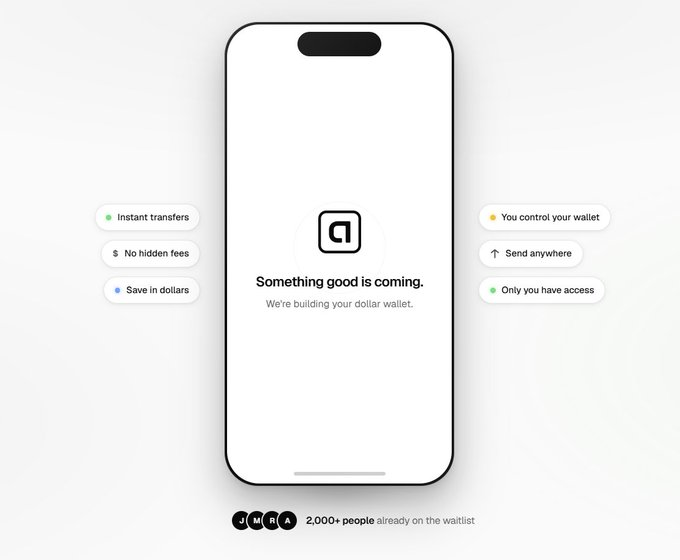
In mid-2026, AIAI Holdings and Constellation Network publicly launched Arca Wallet: a self-custodial mobile wallet for digital dollars, live on the App Store and Google Play.
What Arca Is
Strip away the crypto vocabulary and Arca is simple: a dollar account that lives on your phone and doesn't require a bank.
The wallet holds USDC and USDT, the two dominant U.S. dollar stablecoins, issued and redeemable by third parties. Users sign up with an email or social login in about thirty seconds; there's no minimum balance and no prior crypto experience required. It's fully self-custodial: users hold their own keys, with Constellation CEO Ben Jorgensen summarizing the design principle as your wallet and everything in it belongs to you. Under the hood, modern wallet security (including trusted execution environments) does the heavy lifting so users never have to think about it.
And critically for mainstream users, Arca sands off every splinter that has kept normal people out of crypto: no seed phrases, no gas fees (Arca covers network transaction costs, leaving only its disclosed flat fee), no network selection. Blockchain runs the machinery; the user just sees dollars.
The Killer Use Case: Cross-Border Money
AIAI is leaning hard on one number: Arca settles international transfers in seconds for a flat 0.5% fee.
Compare that against the incumbent world it's attacking. Wire transfers take one to five business days. Global remittance costs average 6.36%, meaning a worker sending $300 home surrenders roughly $19 to intermediaries and waits days for delivery. Through Arca, that same transfer costs $1.50 and lands before the phone call announcing it ends.
The remittance market moves hundreds of billions of dollars a year, disproportionately from people who can least afford the fees. Meanwhile the stablecoin rails underneath are exploding: trillions in annual settlement volume, multibillion-dollar credit-union pilots, new institutional liquidity layers, and regulatory approvals landing in markets like Japan. Even BlackRock, Apollo, and a16z have poured hundreds of millions into institutional stablecoin-chain infrastructure like Circle's Arc. The rails are being built at civilizational scale. Arca's bet is on owning the human interface to them.
Not a Bank: On Purpose
The company is unambiguous about what Arca isn't: it's not a bank, digital dollars in the wallet are not bank deposits, not FDIC-insured, and not guaranteed by any government. That's the honest trade of self-custody: you exchange institutional guarantees for direct ownership and permissionless access.
For a comfortable American with three banking apps, that trade may seem pointless. For the billion-plus adults who are unbanked, underbanked, or living under double-digit inflation, it's the entire point. A dollar account that requires only an email address is financial infrastructure most of the world has never been offered.
Beyond Sending: The Marketplace
Arca launched with an ambition bigger than transfers. An in-app marketplace connects partner services directly to the wallet: seven partners integrated at launch, including Bitrefill for gift cards, Nadanada for eSIM and VPN services, and LottoWorks for verified, on-chain lottery draws. A waitlist of thousands queued for early access before general availability.
The pattern to notice: verified lottery draws are Digital Evidence again, the same trust primitive from defense logistics and Gate AI audit trails, now powering consumer fairness guarantees. One primitive, every market. And a wallet with a marketplace isn't just a utility; it's a distribution channel, positioned for the moment commerce itself becomes agentic.
Where Arca Fits the Thesis
At first glance, a consumer stablecoin wallet looks like a detour from "verified data for AI." It isn't. It's the third leg of a deliberate structure the community has started calling the four-product thesis:
Secures the data
Secures the intelligence
Secures the value
Captures real-world activity
There's also a colder strategic read. Enterprise and defense sales cycles are long. Gate AI revenue will build over quarters. A consumer payments product with a per-transaction fee generates activity now, produces metrics a Nasdaq-listed parent can report now, and onboards precisely the demographic (mobile-first, bankless, global) that adopts new financial rails fastest.
And recall Consensus Miami: PayPal and Google Cloud publicly acknowledged that AI agents structurally cannot obtain bank accounts, making crypto rails the default payment layer for agentic commerce, with the vast majority of merchants already seeing agent traffic. When agents need to hold and spend dollars, they'll need exactly what Arca is: self-custodial, programmable, bankless dollar infrastructure. Arca is a consumer product today and an agent-economy beachhead tomorrow.
The Watchpoints
As with Gate AI, honesty requires naming the hurdles. The wallet market is savagely competitive, and Coinbase, PayPal, Telegram wallets, and a hundred fintechs all want the same user. Adoption metrics, not app-store presence, will decide this: monthly active users, transfer volume, marketplace transactions. Regulatory treatment of self-custodial stablecoin apps also remains a moving target across jurisdictions.
Coinbase, PayPal, Telegram wallets, and dozens of fintechs are competing for the same mobile user. App-store presence is not adoption. Monthly active users, transfer volume, and marketplace transactions are the metrics that matter.
Self-custodial stablecoin apps sit in a jurisdictional gray zone that is shifting quickly. Watch for licenses, blocked markets, and any changes in how regulators classify non-custodial wallet software versus money services.
The use case is enormous and the value proposition is clear, but last-mile cash-in and cash-out partnerships, local compliance, and user education decide whether a wallet becomes a verb or just another app icon.
But the strategic picture after Parts 7 and 8 is unmistakable. In a single summer, this ecosystem shipped a benchmark-leading enterprise security product and a consumer payments app on the two biggest app stores, while most of the crypto market still has it filed under "dormant 2018 altcoin."
That disconnect (between what's been built and what's been priced) is only understandable when you map the full structure: a Nasdaq equity on top, a protocol in the middle, a token at the base. How value flows between those three layers is the most important, and most misunderstood, question in the entire Constellation story.
The Series So Far
The stablecoin play
Equity, utility, activity
Catalysts, risks, what to watch
Coming Next
Part 9
Equity, Utility, Activity: How the Three Layers Fit Together
The Nasdaq equity on top, the Hypergraph protocol in the middle, and $DAG at the base. How value, demand, and ownership actually flow between them.
DAGDaily
DAGDaily is an independent community publication. Nothing in this series is financial advice. Digital assets are volatile and you can lose money. Always do your own research.
Sources
Self-custodial mobile wallet for digital dollars, live on the App Store and Google Play.
Layer 0 protocol for Verified Data Automation and the infrastructure layer behind Arca Wallet.
AI security and audit gateway covered in Part 7 of the series.
Want more like this?
Get DAGDaily's weekly breakdowns of partnerships, enterprise adoption, and market shifts — straight to your inbox.